An independent graduation cap guide

A tradition worn since 1321

The graduation cap, explained before you buy one.

A graduation cap is a small object carrying a great deal of history, and getting the right one matters more than most graduates expect. This guide walks through what a graduation cap is built from, how it should fit, which style belongs to which ceremony, and what separates a cap that holds its shape from one that collapses halfway through the processional.

700+

Years of academic dress history

3

Main cap styles compared

9"

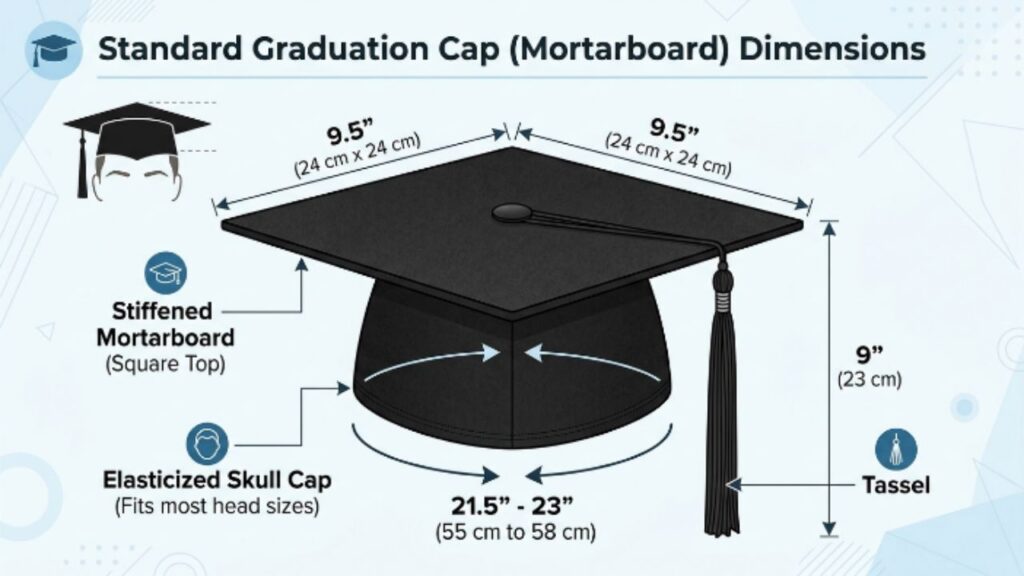
Standard mortarboard width

Graduate wearing a black mortarboard graduation cap with gold tassel, raising the cap during commencement

About the graduation cap

A small square board with seven centuries behind it

The graduation cap most people recognize today, a flat square board fixed on a soft skull cap with a tassel hanging from the center, is formally called the square academic cap, and it is nicknamed the mortarboard because of its resemblance to the flat board a bricklayer uses to carry mortar. Some circles call it a trencher, an Oxford cap, or simply a square, and every one of these names describes the same object.

Its roots reach back to the earliest medieval universities of the twelfth and thirteenth centuries, where scholars and clerics wore soft skullcaps as part of everyday academic dress. Oxford required graduates to wear gowns during ceremonies starting in the fourteenth century, and the flat, square shape gradually took over from rounder cap styles by the sixteenth and seventeenth centuries, eventually settling into the form still used at commencement today.

Tassels are a comparatively recent addition. They were not part of early academic dress and only became common in the eighteenth century, attached to a button at the center of the board. The gesture graduates know best, moving the tassel from the right side of the cap to the left, developed later still as a shorthand for the moment a candidate officially becomes a graduate.

Today the cap is worn far beyond university halls, appearing at high school commencements, kindergarten promotion ceremonies, and professional graduations alike, which is exactly why getting the right size, material and style matters regardless of the level of education being celebrated.

Flat lay of a graduation cap showing the board, button, tassel and soft skull cap base

Anatomy of a cap

  • Board — the stiff, flat square on top, traditionally nine inches per side
  • Button — the center point where the tassel loop is secured
  • Tassel — a bundle of cord strands, usually silk or rayon, hung from the button
  • Skull cap — the soft fabric base that sits against the head
  • Band — the elastic or adjustable strip that holds the cap in place

Why choose a graduation cap

Why the cap still matters at commencement

A cap and gown is optional in a purely legal sense, yet almost no graduate skips it, because the square academic cap does something few other garments can: it turns an individual achievement into a shared, recognizable moment. Here is what a properly chosen graduation cap actually gives a graduate on the day that matters.

A visible marker of achievement

The cap signals, instantly and from a distance, that the person wearing it has completed a defined course of study. It is one of the few pieces of clothing whose entire purpose is to announce an accomplishment.

Comfort through a long ceremony

Commencement ceremonies can run for hours under stage lighting or outdoor sun. A cap built from breathable fabric with a properly fitted band stays comfortable rather than becoming a distraction by the second speech.

A keepsake, not just a costume

A well-made cap holds its shape in storage, which means it photographs well decades later and can be kept as a genuine memento rather than something that gets thrown out the week after the ceremony.

Room for personal expression

Many ceremonies now welcome decorated caps. Choosing a cap with a smooth, paintable surface and a stable board gives graduates a canvas for messages, artwork, or symbols tied to what comes next.

Consistency across a graduating class

Because most institutions specify color and style, choosing a cap that matches the required shade and shape keeps the graduating class looking unified in every ceremony photo.

A gesture with built-in meaning

Moving the tassel from right to left is a small physical action that carries real symbolic weight, marking the exact moment a candidate becomes a graduate in front of family and friends.

Styles compared

Not every graduation cap is a mortarboard

Most graduates only ever wear one style, so it helps to know which one applies to which ceremony before ordering. The three styles below cover almost every commencement in the United States.

Comparison of three academic cap styles: a black mortarboard, a rounded velvet tam, and a Tudor bonnet

Most common

The mortarboard

The flat, square-board cap worn by nearly every bachelor's degree candidate and most high school graduates. Traditionally black, made from wool or matte fabric, and worn with one corner pointed forward rather than facing flat.

Best for: high school & undergraduate ceremonies

Advanced degrees

The academic tam

A rounded, floppy velvet cap with four, six, or eight sides, typically worn by doctoral candidates and faculty. The tam usually pairs with a gold bullion tassel and drapes over the left side of the head.

Best for: doctoral graduates & faculty

Traditional & less common

The Tudor bonnet

A soft, rounded velvet cap dating to the English Tudor period, still used at some Commonwealth institutions in place of the mortarboard for doctoral regalia, though rarely seen at typical American ceremonies.

Best for: select Commonwealth ceremonies

A step-by-step process

How to choose the best graduation cap

Ordering the wrong cap usually only becomes obvious once it arrives, which is too late before a ceremony. Working through these six checks in order avoids nearly every common mistake.

Graduate measuring their head with a soft tape to determine graduation cap size
01

Confirm the required style and color first

Before comparing products, check with the school or institution for the exact cap style and color required, since many ceremonies specify this and a mismatched cap stands out in every photo.

02

Measure your head, not your hat size guess

Wrap a soft tape around the largest part of the head, roughly an inch above the ears, and compare that measurement against the seller's sizing chart rather than assuming a one-size cap will fit everyone equally well.

03

Check what the board is reinforced with

A fiberglass or firm plastic insert keeps the board flat throughout a long ceremony, while a soft cardboard insert can bend, dent, or droop, especially in humid outdoor venues.

04

Decide between elastic and adjustable bands

An elastic band is quick to put on and works for most head sizes, while an adjustable strap or velcro closure gives a more secure, snug fit for anyone who plans to move, wave, or take part in a lot of photos.

05

Match the fabric to the setting

Matte polyester resists glare from stage lighting and photography flashes, while velvet suits indoor doctoral ceremonies with a more formal dress code. Choose the finish that suits the venue and required regalia.

06

Order early enough to fix a bad fit

Ordering a graduation cap at least two to three weeks ahead of the ceremony leaves enough time to exchange it for a different size if the fit turns out to be off, without the stress of a last-minute scramble.

What a good cap is built from

Build materials and quality control

The difference between a graduation cap that survives the ceremony intact and one that sags, slips, or tears usually comes down to a handful of construction details most buyers never think to check. Here is what actually goes into a well-made cap.

Outer fabric

Matte polyester is the standard choice for student caps because it is lightweight, resists wrinkling in storage, and avoids the shine that shows up harshly under stage lighting. Poplin offers a smoother, slightly crisper finish. Velvet is reserved almost exclusively for doctoral tams and premium mortarboards, prized for its texture but requiring more careful storage to avoid crushing the pile.

Board core

The stiffness of the top board comes from an internal insert. Fiberglass sheeting is the modern standard because it stays flat, resists warping in heat or humidity, and holds a crisp edge. Cardboard is lighter and cheaper but tends to soften and bend after repeated handling. Reinforced plastic sits between the two, offering more rigidity than cardboard without the added cost of fiberglass.

Tassel construction

Tassels are traditionally silk on formal doctoral regalia and rayon on standard student caps, made from dozens of individual cord strands gathered under a decorative sheath and finished with a metallic year charm. A higher strand count generally produces a fuller, less thin-looking tassel.

Band and closure

The inner band, whether elastic, adjustable strap, or velcro, is what actually keeps the cap on the head. Double-stitched elastic seams and a wider band distribute pressure more evenly and are far less likely to snap mid-ceremony than a thin, single-stitched strip.

Close-up texture shot of graduation cap fabric options including matte polyester and velvet
Close-up of stitching and seam inspection on a graduation cap during quality control

A short quality control checklist

Before buying, or right after a cap arrives, run through these checks to catch the defects that cause most complaints.

  • 01Press the corners of the board — they should feel firm, not spongy or loose.
  • 02Check the seam where the board meets the skull cap for even, unbroken stitching.
  • 03Tug the button gently to confirm the tassel loop is anchored securely.
  • 04Stretch the band to check it returns to shape without feeling brittle.
  • 05Hold the fabric up to light and check for uneven dye or visible thin spots.
  • 06Count the tassel strands loosely — a noticeably thin tassel usually signals a lower grade product.

Quick reference

General graduation cap sizing

Sizing conventions vary between manufacturers, so always confirm against the specific chart for the cap being purchased. The ranges below reflect the most common labeling used across student graduation caps.

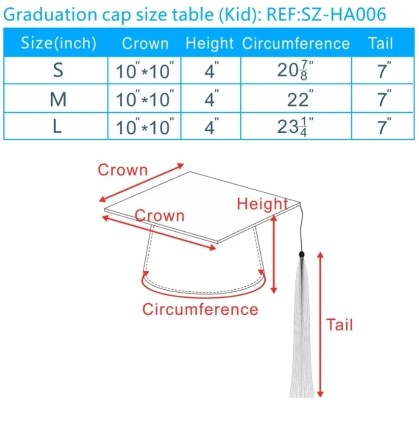
Size label Head circumference Typical wearer Closure type
One size / Standard21" – 23.5"Most teens and adultsElastic band
Small / Medium20.5" – 22"Younger students, smaller framesAdjustable strap
Large / X-Large22.5" – 24"Larger head circumference adultsAdjustable strap or velcro
Professional tamMade to sizeDoctoral graduates & facultyVelcro with gap allowance

From our readers

What graduates say after the ceremony

These reflections are drawn from graduates and parents who used this guide before ordering, shared here to illustrate common experiences and what tends to matter most once cap day arrives.

★★★★★

The sizing guide saved me from ordering the wrong size for my daughter. The board stayed perfectly flat through a two-hour outdoor ceremony in direct sun, which was exactly what the fiberglass explanation promised.

Parent of a high school graduate

★★★★★

I did not know the tam and mortarboard were different things until I read the comparison here. Glad I checked before ordering, since my program required the tam for the doctoral hooding.

Doctoral candidate

★★★★☆

Ordered a matte polyester cap based on the materials breakdown and it held up perfectly for both the rehearsal and the actual ceremony. Wish I had known about the quality checklist sooner.

Undergraduate class of 2026

Ready when you are

Found the style, material and size that fits your ceremony?

Browse a wide selection of graduation caps and find the option that matches what you have learned on this page.

Shop Graduation Caps Now

Frequently asked questions

Graduation cap questions, answered plainly

What is a graduation cap actually called? +
The formal name is the square academic cap. It is commonly nicknamed the mortarboard because of its resemblance to the flat board a bricklayer uses to hold mortar, and it is also referred to as an Oxford cap, a trencher, or simply a square.
What is a graduation cap made of? +
Most graduation caps combine a stiffened board, historically wool or cardboard and now most often lightweight fiberglass or reinforced plastic, with an outer covering of matte polyester, poplin, or velvet for doctoral styles, stitched over a soft fabric skull cap with an elastic or adjustable band.
Which side does the tassel start on? +
Tradition places the tassel on the right side of the cap before the diploma is conferred, then it is moved to the left to mark the change in status from candidate to graduate.
How do I know what size graduation cap to order? +
Measure around the largest part of your head with a soft tape, just above the ears and eyebrows, and match that number to the sizing chart of the specific cap you are considering, since sizing can vary between one-size-fits-most elastic styles and fitted adjustable styles.
How should a graduation cap sit on the head? +
The wider part of the skull cap sits toward the back of the head, with the flat board kept level and parallel to the ground, and one corner of the board pointed forward rather than facing flat to the front.
Can a graduation cap be reused, or is it single-use? +
A well constructed cap with a rigid board and reinforced stitching can be kept as a keepsake or reused for a second ceremony, though many schools issue caps as part of a rental package that must be returned.
Is it okay to decorate a graduation cap? +
Many ceremonies now welcome personalized caps, decorated with paint, fabric, or attachments celebrating the graduate's achievement, though some institutions restrict decoration during the formal procession, so checking the commencement guidelines first is worthwhile.
What is the difference between a mortarboard and a tam? +
A mortarboard is flat and square, worn mostly by high school and bachelor's degree graduates, while a tam is a rounded, floppy velvet cap with several sides, typically worn by doctoral candidates and faculty and paired with a bullion tassel.
Close-up of a gold graduation cap tassel attached to the center button of a mortarboard

One last detail worth getting right

A cap is easy to forget until the day it matters

Most graduates think about their gown, their shoes, even their haircut, long before they think about the cap sitting on top of it all. Yet the cap is the piece that ends up in nearly every photograph, the piece thrown into the air at the end, and often the piece kept in a box for years afterward.

Taking a little time to understand what a graduation cap is made of, how it should fit, and which style belongs to which ceremony turns a last-minute purchase into a small decision made with confidence.

Shop Graduation Caps Now